

As a supplier of Pan Tilt Systems, I often encounter inquiries from customers about the applicability of these systems in low - light conditions. This is a crucial question, especially considering the diverse environments where surveillance and other applications of Pan Tilt Systems are required. In this blog, I will delve into the topic and explore whether a Pan Tilt System can be effectively used in low - light scenarios.
Understanding Pan Tilt Systems
Before discussing their performance in low - light conditions, let's first understand what Pan Tilt Systems are. A Pan Tilt System allows a camera or other device to move horizontally (pan) and vertically (tilt). This movement capability provides a wider field of view, enabling users to monitor large areas without the need for multiple static cameras. These systems are widely used in security surveillance, wildlife observation, live event streaming, and many other fields.
Challenges in Low - Light Conditions
Low - light conditions present several challenges for any imaging device, including those integrated with Pan Tilt Systems. The most obvious issue is the lack of sufficient light to capture clear images. In such environments, images can appear grainy, dark, and lack details. This is mainly due to the limited amount of light reaching the camera's sensor.
Another challenge is the longer exposure times required to capture enough light. When the exposure time is increased, any movement of the camera or the subject can result in motion blur. Since Pan Tilt Systems are designed to move, this can be a significant problem. Additionally, low - light conditions can also affect the color accuracy of the images, making them appear washed - out or with an unnatural color cast.
How Pan Tilt Systems Can Overcome Low - Light Challenges
Advanced Sensor Technology
Modern Pan Tilt Systems are equipped with advanced image sensors that are more sensitive to light. These sensors can capture more photons even in low - light conditions, resulting in brighter and clearer images. For example, some high - end sensors use back - illuminated (BSI) technology, which allows for better light absorption and improved performance in low - light situations.
Infrared (IR) Illumination
Many Pan Tilt Systems come with built - in infrared (IR) illuminators. IR light is invisible to the human eye but can be detected by the camera's sensor. By using IR illumination, these systems can provide additional light in low - light environments without being noticeable. This is particularly useful in security applications where covert surveillance is required. For instance, the Intelligent Hidden Security Camera in Landscape Network PTZ Camera with OEM Service for Safe City is designed with IR technology to ensure clear monitoring even in complete darkness.
Low - Light Image Processing Algorithms
Manufacturers have developed sophisticated image processing algorithms to enhance the quality of images captured in low - light conditions. These algorithms can reduce noise, improve contrast, and enhance details. They work by analyzing the image data and making adjustments to optimize the visual output. Some systems also use dynamic range compression to balance the bright and dark areas of the image, resulting in a more evenly lit and detailed picture.
Case Studies
Let's take a look at some real - world examples of Pan Tilt Systems being used in low - light conditions.
Security Surveillance in Parking Lots
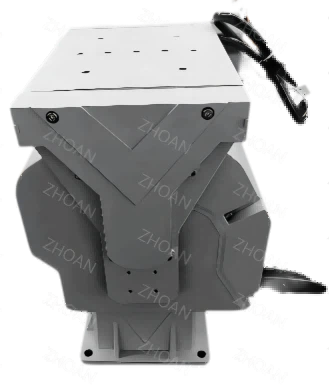
In parking lots, especially at night, the lighting is often insufficient. A Pan Tilt System with IR illumination can be installed to monitor the area. The system can pan and tilt to cover different sections of the parking lot, and the IR light ensures that the vehicles and people are clearly visible. For example, the Variable Speed Medium Duty Motorized Pan Tilt Head With15kg (33.07lb) Payload can support a camera with IR capabilities, providing reliable surveillance in such low - light environments.

Wildlife Observation at Dusk and Dawn
Wildlife photographers and researchers often need to observe animals during the early morning or late evening when light levels are low. A Pan Tilt System can be used to track the movement of animals. With a camera that has good low - light performance, they can capture high - quality images and videos. The ZA - PT306 - 30ZT19 Dual - Spectrum PTZ Pan Tilt Camera is suitable for this application as it can operate effectively in low - light conditions and has the ability to pan and tilt to follow the animals.
Limitations
Despite the advancements in technology, there are still some limitations to using Pan Tilt Systems in low - light conditions. The range of IR illumination is often limited, and in very large areas, additional lighting may be required. Also, extremely low - light conditions, such as in a completely dark cave or a deep forest at night, can still pose challenges even for the most advanced systems.
Conclusion
In conclusion, a Pan Tilt System can be used in low - light conditions, but it depends on the specific requirements and the capabilities of the system. With the use of advanced sensor technology, IR illumination, and image processing algorithms, these systems can overcome many of the challenges presented by low - light environments. However, it is important to choose the right system based on the application and the level of low - light performance needed.
If you are interested in purchasing a Pan Tilt System for low - light applications, we are here to assist you. Our team of experts can help you select the most suitable system for your needs. Contact us to start the procurement and negotiation process, and let us work together to find the best solution for your low - light monitoring requirements.
References
- "Digital Image Processing" by Rafael C. Gonzalez and Richard E. Woods
- "Camera Technology Handbook" by F. Douglas Cheney and James F. Janesick


